Open WebUI, Docling OCR & Qdrant Cost Models (9 Guides)
Deterministic memory sizing, vector quantization ratios, and container limits across 100k-1.5M chunks and 5-250 team seats.
9 Audited Engineering Guides
Uvicorn Worker RSS
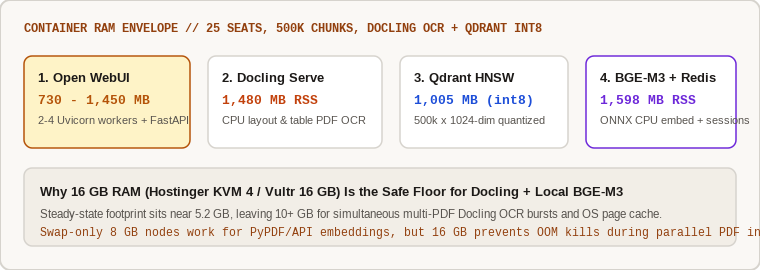
Each Uvicorn worker process adds ~185 MB base RSS plus ~5 MB per active concurrent user; oversizing workers wastes GBs of RAM.
Qdrant 1M HNSW RAM
One million 1024-dimensional float32 vectors consume ~4.25 GB RAM in HNSW; enabling int8 scalar quantization cuts memory to ~1.83 GB.
Docling CPU vs GPU OCR
Docling Serve on 4-8 CPU cores uses ~1.48 GB RAM and parses complex PDF tables at $9.99-$19.99/mo—avoiding $350/mo GPU server rent.
Redis WebSocket State
A capped 192 MB Redis 7 container eliminates dropped token streams and auth desync when running 2-4 Open WebUI Uvicorn workers.
pgvector vs Qdrant RAM
pgvector simplifies small stacks (<150k chunks), while Qdrant int8 saves ~40-55% RAM and eliminates Postgres index-build memory spikes at 500k+.
BGE-M3 CPU Latency
Running BGE-M3 on CPU reserves ~1.38 GB RAM and embeds live user queries in 35-65 ms while bulk-indexing ~18-32 chunks/sec on 4-8 vCPUs.
Apache Tika Heap
When 95% of your files are born-digital PDFs, DOCX, and XLSX sheets, Apache Tika runs in ~580 MB RAM—saving 900 MB over Docling OCR.
BM25 + Reranker RAM
Enabling BM25 + dense hybrid search adds ~180 MB overhead while boosting exact SKU/error-code recall; cross-encoder reranking adds ~1.1 GB.
LiteLLM Budget Caps
A 256 MB LiteLLM container prevents runaway BYOK API bills by enforcing per-user dollar ceilings, prompt caching, and tiered model routing.